Skip to content

Concrete · Edmonton, Alberta

Concrete Contractor in Edmonton

Driveways, sidewalks, garage pads, slabs, curbs and foundations formed, poured and finished by our own crews, and detailed to survive an Alberta winter.

Concrete is the least forgiving trade we do. Once it is placed you have a few hours to get it right and then thirty years to live with the result, and in this climate the result is tested every single spring. A concrete contractor Edmonton owners should hire is one who spends the time on the base and the mix, because that is where flatwork is won or lost.

We form, pour, finish and seal driveways, walkways and patios, garage pads, structural slabs, foundations, curbs, gutters and edging, for residential and commercial properties across the region. The power trowel work, the forming and the prep are all ours — nothing about the pour is handed to somebody else.

Alberta breaks concrete in a specific way: water gets into the pores, freezes, expands, and takes a little of the surface with it each cycle. Air entrainment, a properly compacted granular base, correct thickness and reinforcement, joints cut where the slab will crack anyway, and a real cure are the things that stand up to it.

Driveway Replacement in Edmonton

Driveway replacement Edmonton homeowners put off usually reaches a point where patching no longer helps: the surface is spalling, panels have heaved or dropped relative to each other, or a crack has opened wide enough to take water straight into the base. At that point replacing costs less over time than repeatedly repairing.

A replacement is mostly excavation. The old slab is broken out and hauled away, the subgrade is dug down and any soft clay removed, then granular base is placed and compacted in lifts to a depth that will not settle. Reinforcement goes in, the pour is formed to fall away from the garage and the house, and control joints are cut so the inevitable cracking happens in a straight line where nobody notices it.

What drives the cost is rarely the concrete itself. It is access for the equipment, the volume of material coming out, how far a truck can reach, whether the existing base has to be rebuilt, and the disposal. A driveway off a tight rear lane with mature trees is a different job from one on an open corner lot, and the quote reflects that.

  • Break-out, removal and disposal of the existing slab
  • Subgrade excavation and compacted granular base
  • Reinforcement, forming and slope set away from the building
  • Power trowel or broom finish, control joints cut, edges tooled
Concrete Sidewalks, Walkways, Steps and Curbs

A concrete sidewalk has to shed water, sit flat through frost, and match the elevation of whatever it meets at both ends. We pour residential walkways and steps, commercial sidewalks and pathways, curbs, gutters and the curved poured edging that separates turf from planting beds and keeps the whole landscape crisp.

Frost heave is the enemy of narrow flatwork. A walkway is light, so it moves more readily than a driveway when the ground under it lifts. Getting the base right — good granular, compacted, drained, with soft material removed — is what stops a path from turning into a set of mismatched steps after a couple of winters.

One caution worth knowing before you plan the work: the sidewalk, boulevard and curb crossing in front of a property are typically in the road right-of-way, which is public land rather than yours. Work that touches them generally needs approval from the municipality, separate from anything on your own lot. Requirements change, so confirm the current ones with the City before you book — we will tell you when a job crosses that line.

Garage Pads, Slabs and Foundations

A garage pad carries concentrated loads, gets dragged with salt and slush off a vehicle all winter, and sits on ground that heaves. It needs the thickness, the reinforcement and the base to match, and it needs to be sloped so meltwater running off a car in March leaves the building instead of sitting against the sill plate.

On the commercial side we form and pour structural slabs, columns, pads and foundations, and finish them with a power trowel to the flatness the use requires. Slabs that will carry equipment or traffic are specified differently from a residential floor, and the reinforcement, thickness and joint layout follow the engineering rather than habit.

Foundation and footing work is tied to frost depth. In central Alberta the frost line runs well below a metre, and footings placed above it will heave. We dig to the depth the design and the inspection call for.

The Concrete Season and Cold-Weather Pours

The comfortable concrete season here runs roughly April to October. Inside that window the ground is thawed, ambient temperatures let concrete hydrate at a normal rate, and curing is straightforward. It is also the busiest window in the region, so booking early in the season gets you a better date than calling in August.

Pours outside that window are possible but they are a different job. Cold-weather work means heated water or accelerators in the mix, ground thawing before placement, hoarding and insulated blankets over the slab, and monitoring so the concrete reaches strength before it is allowed to freeze. Concrete that freezes in its first days loses strength permanently and no finishing repairs it. We will tell you honestly when a late pour is worth doing and when waiting until spring is the better call.

For exposed flatwork we specify air-entrained concrete. The entrained air gives freezing water somewhere to expand into, and it is the single most important thing separating a driveway that still looks good in a decade from one that is flaking by year three.

Making Concrete Last Through Alberta Winters

New concrete needs a first winter of care. De-icing salts are hard on any slab and hardest on a young one, so for the first winter keep them off entirely and use sand for traction instead — it does the same job for grip without attacking the surface. After that, use the least aggressive product that works.

Sealing is worth doing on exposed flatwork and worth repeating. A sealer slows water uptake, which is what makes freeze-thaw damage possible in the first place, and it also helps with the staining that comes off vehicles.

Concrete cracks. Every slab does, everywhere, and in a climate with this much thermal movement it is guaranteed. What good work controls is where: joints cut at the right spacing and depth give the slab a place to relieve stress in a straight line. A hairline crack at a joint is the system working, not a defect.

How It Works

From first call to finished job

  1. Step 01

    Site visit and measure

    We measure the area, check access for equipment and trucks, look at how water currently drains and confirm what has to come out first.

  2. Step 02

    Free quote

    A written quote covering removal and disposal, base, reinforcement, thickness, finish and joints — so you can see what is actually being priced.

  3. Step 03

    Break-out and base

    The existing surface is removed and hauled away, the subgrade is excavated and any soft material taken out, then granular base is placed and compacted in lifts.

  4. Step 04

    Form, pour and finish

    Forms are set to the finished slope, reinforcement goes in, the concrete is placed, screeded and finished, and control joints are cut at the right spacing.

  5. Step 05

    Cure and hand-over

    The slab is cured and protected, forms are stripped and the site is cleaned. You get plain instructions on when to walk on it, when to drive on it and how to treat it through the first winter.

Concrete work in Edmonton

Photos from our own sites — no stock images.

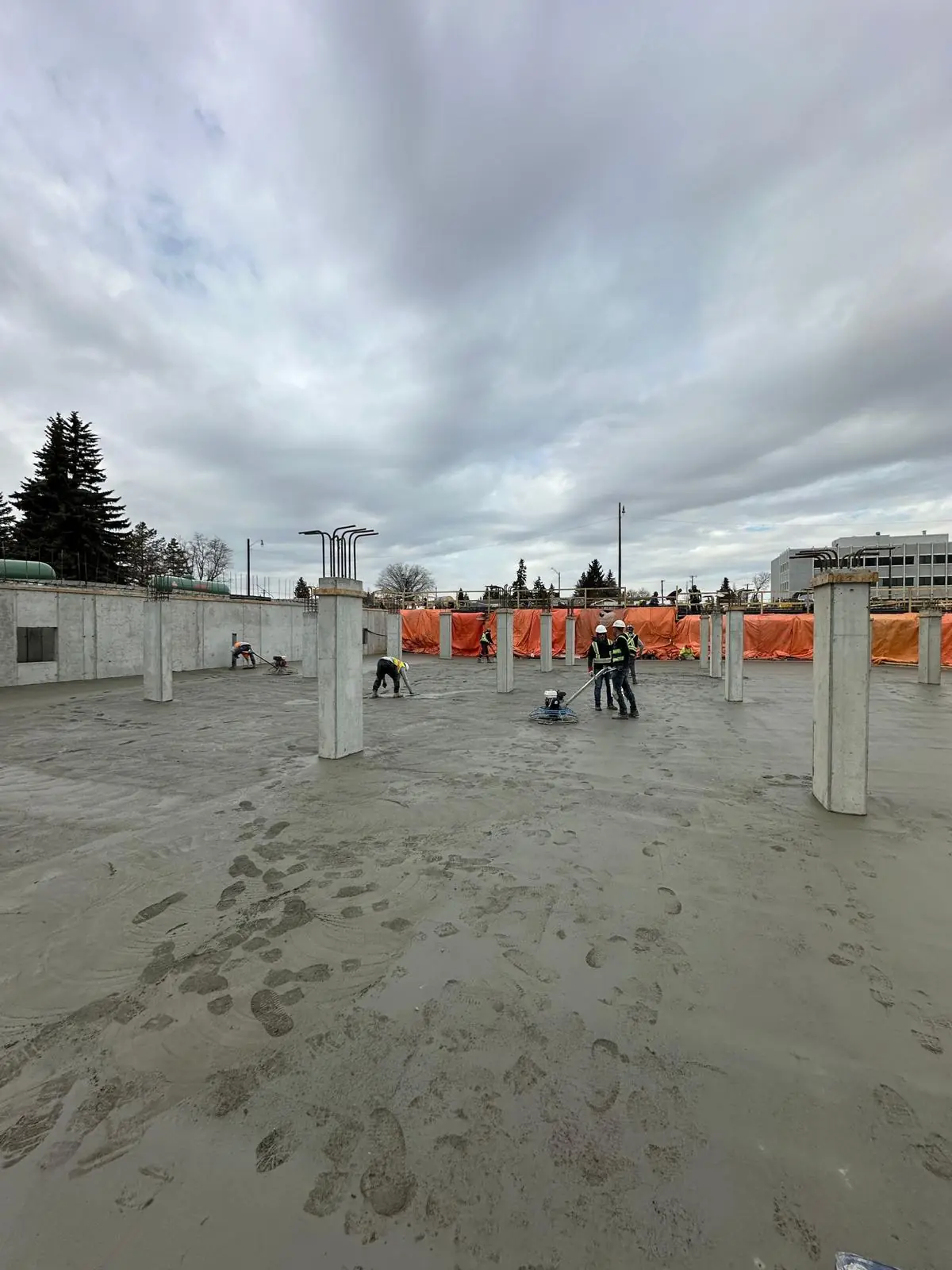
  • Crew finishing a large poured concrete slab with a power trowel between structural columns

    Structural slab — power trowel finish

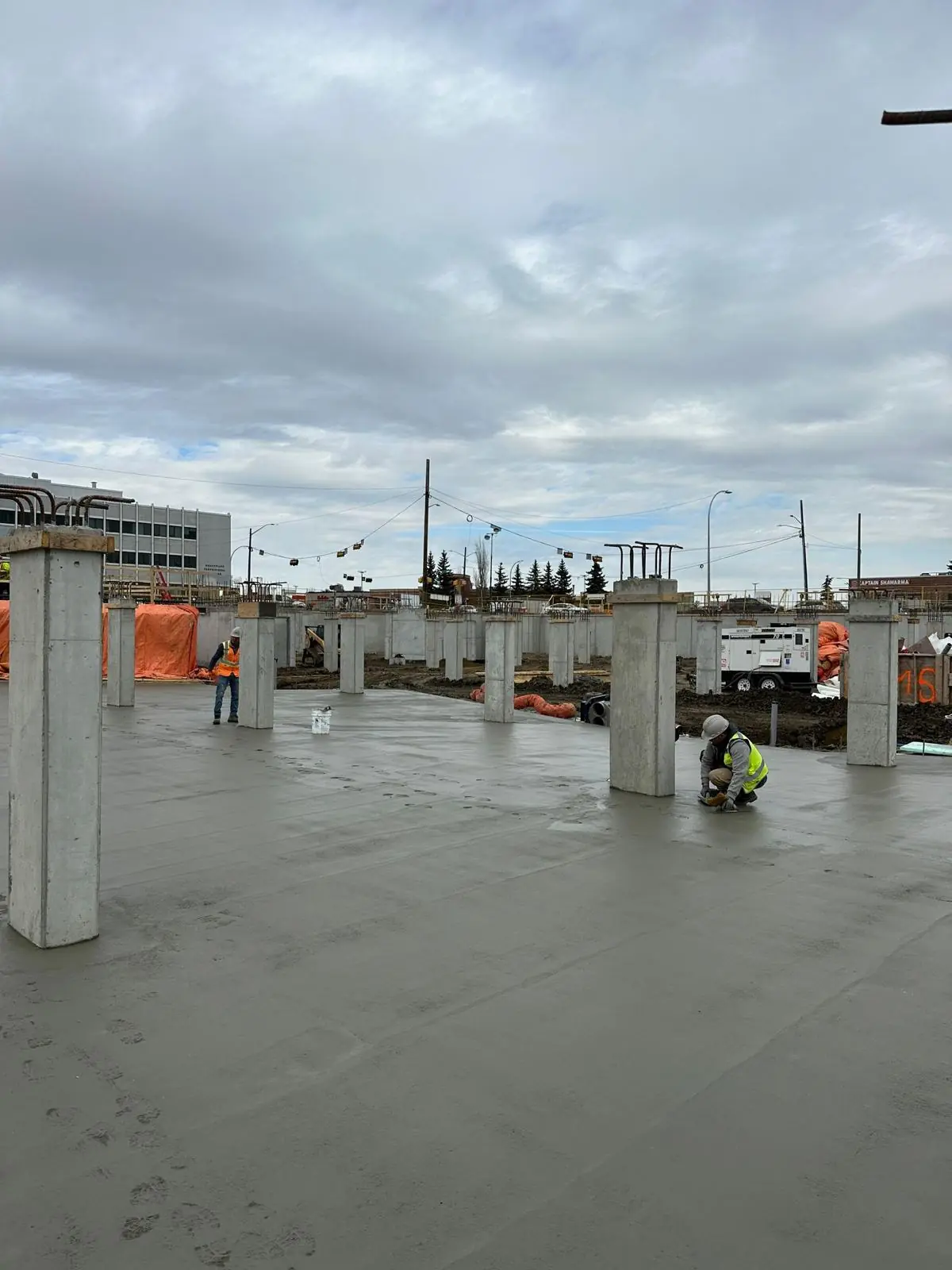
  • Formed concrete columns rising from a finished slab on an Edmonton commercial build

    Columns & slab — commercial build

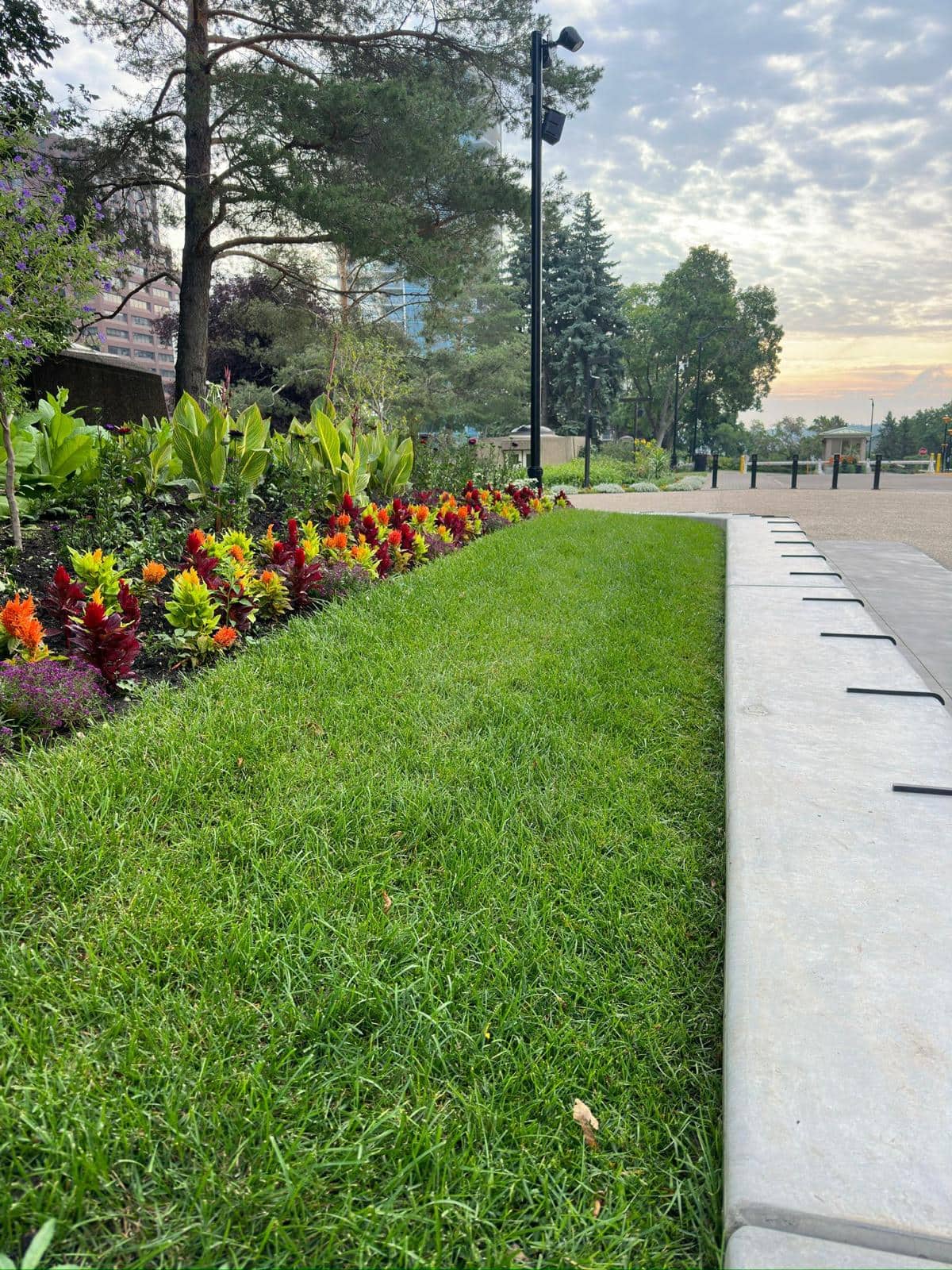
  • Curved concrete curb and walkway separating turf from marigold beds at the Alberta Legislature

    Curved curb & walkway with planting

  • Mixed perennial and annual bed beside fresh turf and a poured concrete curb at dusk

    Bed planting with poured curb edge

See the full project gallery

Concrete across Edmonton and the surrounding areas

Our crews travel out of Edmonton to the communities around it. Pick yours to see what we do there.

Concrete questions we get asked

When can concrete be poured in Edmonton?

The normal season runs from roughly April to October, once the ground has thawed. Pouring outside that window is possible with heated mixes, ground thawing, hoarding and insulated blankets, but it costs more and needs monitoring, because concrete that freezes before it gains strength never fully recovers. We will tell you when waiting for spring is the better decision.

How long before I can drive on a new driveway?

Concrete keeps gaining strength for weeks after the pour. Foot traffic is usually fine within a day or two, but vehicles need substantially longer, and heavy loads longer still. We give you the specific timing for your pour based on the mix and the weather at the time rather than a blanket number.

Do I need a permit to replace my driveway?

Work entirely on your own property is treated differently from work that touches the sidewalk, boulevard or curb crossing, which sit in the road right-of-way and generally require municipal approval. Requirements and fees change, so confirm the current ones with the City of Edmonton or your municipality before booking. We will flag it when a job crosses into the right-of-way.

Why is my concrete flaking at the surface?

That is usually freeze-thaw scaling, often accelerated by de-icing salt. Water soaks into the surface, freezes, expands and lifts a thin layer off, and each cycle takes a little more. Air-entrained concrete, a proper cure, sealing, and keeping salt off — especially in the first winter — are what prevent it.

Can you match new concrete to my existing slab?

We can match the finish and get close on the elevation and joint pattern, but new concrete will not match the colour of weathered concrete, and it never will exactly — the old slab has years of exposure on it. Where appearance matters, replacing the full area gives a better result than patching a panel.

Need concrete in Edmonton?

Tell us what the job involves and we will come back with a free, no-obligation quote.

Mon – Sat, 8:00 AM – 6:00 PM · 24/7 response during snow events